ISO 9001:2015 ISO 13485:2016


|
Objective
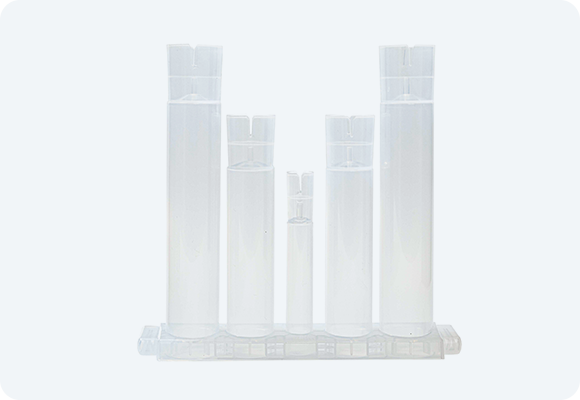
Custom molding of syringe clip parts for a pharmaceutical single - use bioreactor project. The parts need to be biocompatible, made from specific resins (USP VI), and meet strict dimensional requirements, such as zero draft on the inside of the barrels and no scratches during mold release. Additionally, the gate location is a critical factor due to potential core shift issues as indicated by MoldFlow analysis.
Solution
DFM (Design for Manufacturability):
VIDA's team of experts conducted a thorough Design for Manufacturability analysis on the syringe clip parts. Considering the requirement of biocompatibility and the need to avoid additives/mold release agents, suitable processing methods were selected. For the clear polypropylene injection - molded vessel and headplate, the design was optimized to ensure proper material flow during injection molding, taking into account the material's characteristics like melt flow rate and viscosity. For the custom silicone gaskets/plugs, the design focused on achieving a perfect seal while maintaining flexibility and biocompatibility. The polypropylene injection - molded connectors and overmolded tubing assemblies were designed with an emphasis on strength and durability, as they would be in contact with cell - culture liquid. Special attention was given to the zero - draft requirement on the inside of the barrels. The mold design incorporated features to facilitate easy part release without causing scratches, such as smooth - surfaced ejection mechanisms and optimized mold parting lines. |
MoldFlow Analysis:
Based on the provided MoldFlow analysis for the syringe clip, VIDA's engineers carefully studied the results. The analysis showed that the current gate location could lead to a pressure differential within the syringe barrels, causing a risk of core shift. To address this, VIDA's team recommended re - evaluating the gate location.
They proposed shifting the gates to be directly on the axes of the cores. This would help minimize the core shift potential during the filling stage. By doing so, the plastic would flow more symmetrically around the core, reducing the likelihood of wall - thickness variations and potential short - shot issues.
VIDA also conducted additional simulations using different gate locations and injection parameters to further optimize the process. This included adjusting the melt temperature, injection time, and hold pressure to ensure the best possible part quality.
 |
 |
Validation
Material Compatibility Validation: Samples of the molded parts were tested to ensure that the selected resins (USP VI) were indeed biocompatible with the cell - culture liquid. These tests followed strict regulatory standards such as FDA - 21 CFR 177/570.l, USP<88> Class VI, USP<85>, and ISO 10993 - 5 to confirm that no harmful substances leached into the liquid.
Dimensional and Surface Quality Validation: The molded parts were inspected for dimensional accuracy, especially focusing on the zero - draft requirement on the inside of the barrels. Precision measuring tools were used to ensure that the draft was within the specified limit of <0.05 mm. Visual inspections and surface roughness measurements were carried out to confirm that there were no scratches on the inside of the parts after mold release.
Core Shift Validation: To validate the effectiveness of the gate - location changes, further MoldFlow simulations were run. Physical prototypes were also produced and inspected for any signs of core shift. The wall thickness of the parts was measured at various points to ensure that it remained consistent and that the core shift issue was resolved.
IQ/OQ/PQ Validation:VIDA conducts rigorous Installation, Operational, and Performance Qualification (IQ/OQ/PQ) on molds, determining the best forming parameters for optimal molded products.
Results
The client received custom - molded syringe clip parts that met all the biocompatibility requirements. The parts were successfully produced without the use of any additives or mold - release agents, ensuring the safety of the cell - culture liquid.
The zero - draft requirement on the inside of the barrels was achieved, and the parts were released from the mold without any scratches. This was a significant improvement over previous designs and manufacturing attempts.
By re - evaluating and adjusting the gate location based on the MoldFlow analysis, the core shift issue was minimized. The parts had consistent wall thickness, and the risk of production failures due to core shift was greatly reduced. This led to a higher - quality product suitable for use in the single - use bioreactor project, enabling the client to move forward with their internal pharmaceutical applications.


